
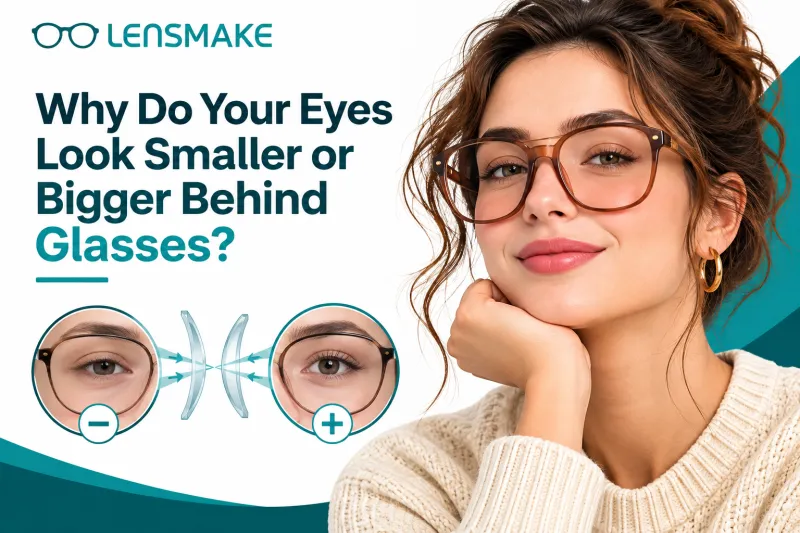
The Science Behind Minus and Plus Lenses, Eye Magnification, and How Glasses Change Your Appearance
Have you ever noticed that some people's eyes look smaller when they wear glasses, while others seem to have noticeably bigger eyes?
Perhaps you've experienced it yourself. You put on a new pair of prescription glasses, look in the mirror, and suddenly your eyes appear different.
It can be surprising, especially when you have chosen frames that perfectly complement your face.
But here's the interesting part: your eyes haven't actually changed size.
What you're seeing is an optical effect created by your prescription lenses.
The way light travels through a lens can change how large or small your eyes appear to someone looking at you.
Understanding this simple science can help you feel more confident about your glasses and make smarter decisions when choosing new frames.
1. Why Do Glasses Change the Appearance of Your Eyes?
Eyeglasses are designed to bend light so that your eyes can focus images more clearly.
This process is called refraction.
Depending on your prescription, the lenses bend light in different ways.
As a result, they can also change the apparent size of objects seen through them—including your eyes.
There are two main effects:
-
Minification: Your eyes appear smaller through certain lenses.
-
Magnification: Your eyes appear larger through other lenses.
These effects are normal consequences of lens optics.
They do not mean your eyes are shrinking, growing, or being physically changed by your glasses.
2. Why Do Minus Lenses Make Your Eyes Look Smaller?
If you have nearsightedness, also called myopia, your prescription usually includes a minus (-) power.
For example, your prescription might be:
-
-1.50 D
-
-3.00 D
-
-5.00 D
Minus lenses are generally thinner in the center and thicker toward the edges.
They spread light rays apart, helping correct the way light focuses in a nearsighted eye.
When another person looks at your eyes through these lenses, the eyes may appear slightly smaller than they actually are.
This is known as minification.
Does a Stronger Minus Prescription Make Eyes Look Even Smaller?
Generally, yes.
As the minus prescription becomes stronger, the minification effect can become more noticeable.
Someone wearing -1.00 D lenses may experience only a subtle change in appearance.
A person wearing -7.00 D lenses may notice a more obvious difference.
However, the exact effect also depends on lens design, lens position, and other optical factors.
Important: Minus lenses do not make your actual eyes smaller. They only change how your eyes appear through the glasses.
3. Why Do Plus Lenses Make Your Eyes Look Bigger?
People with farsightedness, or hyperopia, may be prescribed plus (+) lenses.
Examples include:
-
+1.50 D
-
+3.00 D
-
+5.00 D
Plus lenses are generally thicker in the center and thinner toward the edges.
They converge light rays, helping correct certain focusing problems.
When someone looks at your eyes through these lenses, the eyes can appear larger.
This effect is called magnification.
The stronger the plus prescription, the more noticeable the magnifying effect may become.
This is one reason some people feel that their glasses make their eyes look unusually large.
But again, the effect is optical.
Your actual eye size remains unchanged.
4. Minus vs. Plus Lenses: What's the Difference?
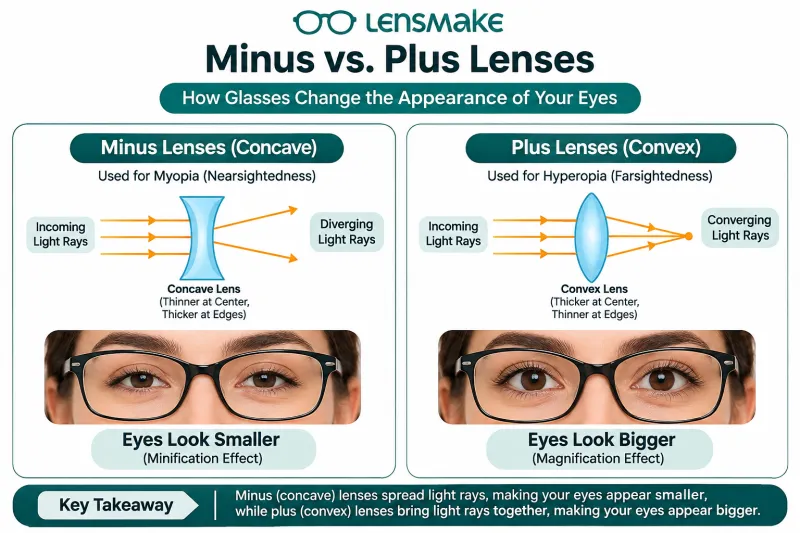
Minus lenses make eyes look smaller while plus lenses make eyes look bigger
The simplest way to understand the difference is to compare their optical behavior.
| Feature | Minus Lenses (-) | Plus Lenses (+) |
|---|---|---|
| Commonly used for | Myopia | Hyperopia |
| Typical thickness | Thicker at edges | Thicker at center |
| Effect on light | Diverges light | Converges light |
| Eye appearance | Smaller | Bigger |
| Optical effect | Minification | Magnification |
| Stronger prescription | More noticeable shrinking effect | More noticeable enlarging effect |
This is why two people wearing similar-looking frames can have very different eye appearances.
The difference is not necessarily the glasses' style.
It is often the prescription inside the frame.
5. Does Prescription Strength Affect How Your Eyes Look?
Yes, prescription strength is one of the most important factors.
A mild prescription may create a very small appearance change.
With a stronger prescription, the effect may become easier to notice.
For example, someone with mild myopia might barely notice that their eyes look smaller.
But a person with a high minus prescription may see a more noticeable difference in photographs or mirrors.
Similarly, strong plus lenses can produce a more obvious magnifying effect.
However, prescription strength is not the only consideration.
The lens material, design, thickness, and distance from your eyes can also influence the final appearance.
This is why two pairs of glasses with the same prescription may not look exactly identical.
6. Can High-Index Lenses Make Your Eyes Look More Natural?
High-index lenses are often recommended for people with stronger prescriptions because they can provide a thinner lens profile than standard-index materials.
They can offer several practical benefits:
-
Reduced lens thickness in suitable prescriptions
-
A potentially lighter and more comfortable finished pair
-
A slimmer appearance, especially around lens edges
-
Greater flexibility when choosing certain frame styles
But there is an important distinction.
Thinner lenses do not automatically eliminate eye magnification or minification.
The apparent size of your eyes depends on the optical properties of the finished lenses, including their power, shape, and position.
A high-index lens may improve the cosmetic appearance of the glasses themselves without dramatically changing the size of your eyes as seen through them.
If this effect concerns you, ask your optician about lens design options rather than focusing only on thickness.
7. Does Frame Size Affect How Big or Small Your Eyes Look?
Yes, frame size can influence the overall visual impression of your glasses.
Large frames can create a different facial appearance compared with smaller frames.
However, there are two separate things to consider:
The optical effect: This comes mainly from your prescription lenses.
The visual styling effect: This comes from the size, shape, color, and proportions of your frames.
For example, oversized frames can make your eyes appear relatively smaller within the large lens openings, even without a strong prescription.
Smaller or moderately sized frames may create a more balanced appearance for some face shapes.
With strong minus prescriptions, larger frames may also result in thicker lens edges.
For this reason, people with higher prescriptions sometimes prefer smaller, well-centered frames.
But that doesn't mean oversized glasses are unsuitable for everyone.
The best frame is one that works with your prescription, fits comfortably, and complements your personal style.
At Lensmake, eyewear is about combining individual style with practical considerations such as frame fit, lens choices, and everyday comfort.
8. Does the Distance Between Your Eyes and Glasses Matter?
Yes. This is an important detail that many people overlook.
The distance between the back surface of your lenses and your eyes is called vertex distance.
Changing this distance can influence the apparent size of your eyes through the lenses.
In general:
-
Moving minus lenses farther from the eyes can increase their minifying effect.
-
Moving plus lenses farther from the eyes can increase their magnifying effect.
For stronger prescriptions, vertex distance can also influence the effective optical power experienced by the wearer.
That is why properly adjusted frames are important.
Glasses that sit too far from your face or constantly slide down your nose may affect both comfort and visual performance.
An optician can help adjust the frame to an appropriate position.
9. How to Make Your Eyes Look More Natural Behind Glasses
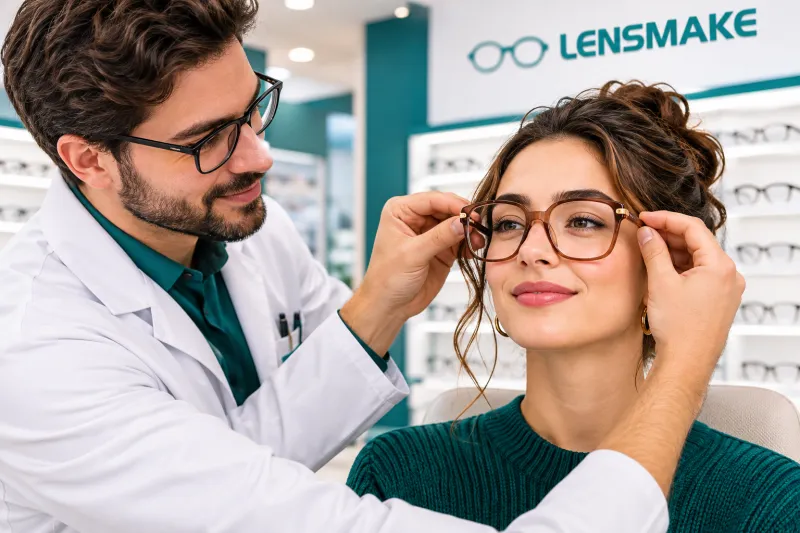
Optician adjusting prescription glasses for proper fit and comfort
If you are concerned about how your eyes appear through prescription lenses, there are several practical options to consider.
Choose Frames That Fit Your Face
A frame that is too large or too small may exaggerate differences in facial proportions.
Look for glasses that feel balanced and comfortable.
Consider Moderate Frame Sizes
For stronger minus prescriptions, moderately sized frames can help reduce unnecessary lens edge thickness.
Ask About Lens Design
Different lens designs may offer cosmetic or optical advantages for certain prescriptions.
An optician can explain what is realistically possible.
Keep Your Glasses Properly Adjusted
The position of your glasses can affect both their appearance and your viewing comfort.
Consider Anti-Reflective Coatings
Anti-reflective coatings can reduce distracting reflections and make your eyes easier to see through the lenses.
However, they do not remove the underlying magnification or minification effect.
Don't Sacrifice Clear Vision for Appearance
Your prescription should be selected according to your visual needs—not altered simply to change how large your eyes look.
The goal is to find a comfortable, attractive pair of glasses that provides appropriate vision correction.
10. Do Contact Lenses Make Your Eyes Look Smaller or Bigger?
Contact lenses usually produce much less noticeable spectacle magnification or minification because they sit directly on the eye rather than some distance in front of it.
For this reason, people with strong prescriptions may notice that their eyes look different when switching between eyeglasses and contact lenses.
However, contact lenses are not suitable for everyone.
They require proper fitting, hygiene, and professional guidance.
If you are considering contact lenses for cosmetic reasons, discuss your options with an eye care professional.
11. Can Glasses Permanently Change the Size of Your Eyes?
No.
Prescription eyeglasses do not permanently shrink or enlarge your eyeballs.
The change in appearance happens because light passes through the lenses before reaching the observer.
When you remove the glasses, that optical effect disappears.
Glasses are designed to correct vision, not physically change the size of your eyes.
If you notice an actual change in eye appearance, unusual swelling, bulging, or new visual symptoms, seek professional medical advice rather than assuming it is caused by your prescription lenses.
Frequently Asked Questions
Why do my eyes look tiny behind my glasses?
This commonly happens with minus lenses used to correct myopia. They create a minification effect that can make your eyes appear smaller to other people.
Why do some people's glasses make their eyes look huge?
Plus lenses used for hyperopia can magnify the appearance of the eyes, particularly with stronger prescriptions.
Do stronger glasses make your eyes look smaller?
Stronger minus prescriptions generally create greater minification. Stronger plus prescriptions generally create greater magnification.
Will thinner lenses make my eyes look bigger?
Not necessarily. Thinner lenses may improve the appearance and weight of your glasses, but they do not automatically remove the optical effect associated with your prescription.
Do oversized glasses make eyes look smaller?
Oversized frames can change facial proportions and may make eyes appear relatively smaller within the frame. The actual optical minification depends primarily on the lenses.
Can anti-reflective lenses make eyes look more natural?
Anti-reflective coatings reduce reflections and can make your eyes more visible. They do not directly change eye magnification.
Do glasses change your real eye size?
No. Eyeglasses change the apparent size of your eyes through optical effects, not their physical size.
Final Thoughts
If your eyes look smaller or bigger behind your glasses, there is usually a simple scientific explanation.
Minus lenses tend to make eyes appear smaller.
Plus lenses tend to make eyes appear larger.
Prescription strength, lens design, vertex distance, and frame proportions can all influence the final appearance.
But the most important thing to remember is that your glasses are not changing the actual size of your eyes.
They are changing the way light travels—and therefore the way your eyes appear through the lenses.
Instead of worrying about the optical effect, focus on finding eyewear that gives you clear vision, a comfortable fit, and confidence in your appearance.
Explore eyewear styles and practical frame-selection guidance at Lensmake.
About the Author
Md Tauqueer Raza | Shopify Developer at Lensmake
Md Tauqueer Raza is a Shopify Developer at Lensmake with an interest in eyewear fashion, lens technology, e-commerce, and digital shopping experiences.
He enjoys creating helpful articles about eyeglasses, frame selection, and the science behind everyday eyewear.
Website: https://lensmake.com/
Disclosure: The author works with Lensmake, the eyewear brand mentioned in this article.